
Music Dictionary
A comprehensive reference for music terms used in the Treblemakers Piano Method. Use the alphabet navigation or search box to find any term quickly.
#
Extends over a section of music to show that it is played two octaves above where it is written. Lasts for the entire length of the dotted line. This is used to avoid using many ledger lines which is difficult for the eye to read quickly.
Extends below a section of music to show that it is played two octaves below where it is written. Lasts for the entire length of the dotted line. This is used to avoid using many ledger lines which is difficult for the eye to read quickly.
The 20th century period of music covers an approximate time-period from 1920-present. The music from that period reflects styles and traditions that were popular across art and culture during that time. Particular traits that define music from the 20th century period are:
A four note chord that comes from 1, 3, 5 and 7 of its scale. For example, a C major 7th chord is built from the 1st, 3rd, 5th and 7th note of the C Major Scale.

Extends over a section of music to show that it is played one octave above where it is written. Lasts for the entire length of the dotted line. This is used to avoid using many ledger lines which is difficult for the eye to read quickly.

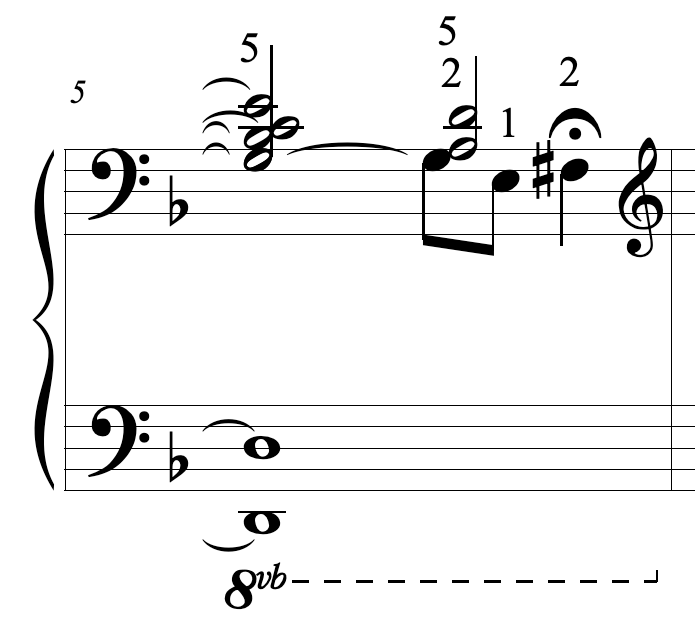
8vb—– Extends under a section of music to show that it is played one octave below from where it is written. Lasts for the entire length of the dotted line. This is used to avoid using many ledger lines which is difficult for the eye to read quickly.
A
Music that is sung without instrumental accompaniament.
Return to the previous tempo (speed).
Gradually speed up.
A symbol that looks like a “v” on its side. Place over or under a notehead to show that the note should be played stronger than the other notes around it to make it stand out.

Also called a grace note. Looks like a miniature eighth note with a line through the flag. It is placed before another note. Played quickly either with the main note landing on the beat or with the accaiccatura note landing on the beat. Should be made to fit into the existing rhythm. In jazz and blues, these notes often happen on blues notes (b3, b5 or b7) and slide into a chord tone.

A sharp, flat or natural that is placed in front of a note but not is not part of the key or scale. This is good only for that specific pitch and lasts for the rest of the measure.


Music that provides harmonic background and support for a main musical part (usually the melody). As an example, piano or guitar often provide accompaniament for singers.
Music that provides harmonic background for a main musical part (melody) or soloist.
An instrument that does not require external power in order to produce sound. Natural amplifying of sound happens through the wood of the instrument.
The science of how sound behaves.
Slow and at ease, stately. Italian name placed on top of music that describes the mood, feeling and general speed to use in playing a passage of music. Roughly from 66-76 bpm (beats per minute).
Agitated and quick. Describes the mood, feeling and general speed to use in playing a passage of music.
Quickly and joyfully. Italian name placed on top of music that describes the mood, feeling and general speed to use in playing a passage of music. Roughly from 120-139 bpm (beats per minute)
A device with a speaker that an electric instrument is plugged into in order for it to produce sound.
In music, this refers to making sound louder. This can be done naturally through the wood of an instrument or artificially though an electric amplifier.
Walking pace. Italian name placed on top of music that describes the mood, feeling and general speed to use in playing a passage of music. Roughly from 76-108 bpm (beats per minute).
Animated and lively. Describes the mood, feeling and general speed to use in playing a passage of music.
Also called a Long Grace Note. Looks like a miniature eighth note placed before another note. The appoggiatura note is played on the beat, then slowly moves to the main note.
Notes of a chord played next to each other separately instead of at the same time. Often played quickly up or down through the chord in order or in repeating patterns.
Tells the performer information about the style in which to play a note. Can refer to the attack of the note when it is first struck and sounds or the delay of the note which is the part of the note that holds. Can also refer to whether the note is connected to the notes around it. Common examples of articulation markings are staccatto, slur and accent.
The beginning part of a note when it is first struck and sounds.
B
Also called a measure. The portion of music on the staff that falls between two bar lines. A segment of time in music. Each bar or measure is made up of the number of beats shown in the top number of the time signature which is at the beginning of the music. Used as a way to divide up and organize time in music.

Line that separates measures or bars of music.

The Baroque period of music covers an approximate time-period from 1600-1750. The music from that period reflects styles and traditions that were popular across art and culture during that time. Particular traits that define music from the baroque period are: Keeping to a steady tempo, No dynamics due to limitations of the harpsichord, Complicated melodies weaved on top of each other (counterpoint), Music was commissioned and performed for church and upper classes, Chamber music consisted of small groups that would often be led by one of the players. Fancy embellishments and improvising were a part of playing. Players followed figured bass markings that indicated the specific voicings to use in playing chords.
Different kinds of clefs are used at the beginning of a staff to show the specific range of notes used in the musical notation. Bass means low so, Bass clef indicates the lower range of notes from middle c on down. Is also called F clef because the two dots of the bass clef surround the F line.

A horizontal line used to attach two or more notes with flags together, making it easier to see how many notes are in a grouping. Beam replaces the flag. One beam for one flag, two beams for two flags etc.

A kind of acciaccatura or grace note that happens in jazz or blues on the b3, b5 or b7 and slides to the chord tone. Looks like a miniature eighth note with a line through the flag. It is placed before another note. Played quickly either with the main note landing on the beat or with the blue note landing on the beat. Should be made to fit into the existing rhythm.
C
Singing, lyrcial and flowing. Describes the mood or feeling to use in playing a passage of music.
Three or more notes played at the same time that create a harmony. Although sometimes only two notes may be played, it still represents a three note chord. Chords are built from taking specific numbers of the scale. Triads are three note chords and come from the first, third and fifth notes of the scale they are named after. 7th chords are four note chords that come from the first, third, fifth and seventh notes of the scale they are named after. Chords can also be built by altering notes of the major scale or stacking intervals. Chords come in different qualities which have a distinct sound and mood such as major, minor, dominant, diminished and augmented.
Chords can be played with their notes in any order. There are different names for these positions such as root position, first inversion, second inversion and third inversion. This allows musicians and composers to be specific about what order they would like the notes in the order to be played in.
Quality describes how a chord sounds. Each chord quality has a specific formula and character or mood. Some examples of chord qualities are major, minor, diminished or augmented. To understand how chord qualities are built see the video playlist: Understanding Scales and Chords. For a reference sheet on how to build chord qualities see: Chord Quality Dictionary. Chord qualities are built either from taking notes that fall on specific numbers of the scale they come from or by altering notes form the major scale.

Refers to the choices made in playing chords. Chords can be played with notes in different orderings, notes can be left out or doubled. In piano music, notes can also be split between hands. Different styles of music have specific chord voicings that are commonly used in their genre.
Describes the pattern of scales going through the 13 different keys. Starting with C Scale (no sharps or flats) it goes up 5 notes in the scale to reach the next scale. Each time it adds one sharp in the order of sharps (FCGDAEB). Flats start with C Scale and go down 5 notes in the scale to reach the next scale. Each time it adds one flat in the order of flats (BEADGCF). Download Circle of 5ths (below) and Circle of 5ths Explained for reference. Circle Of 5ths

In music, this can refer to the overall genre of music or to music from the specific classical period. Each period reflects the styles and traditions popular across art and culture during that time. The overall genre of classical music is broken up into the following main periods (dates are approximate):
| Period | Years |
|---|---|
| Baroque Period | 1600–1750 |
| Classical Period | 1750–1820 |
| Romantic Period | 1820–1920 |
| 20th Century | 1920–present |
The classical period of music covers an approximate time-period from 1750-1820. The music from that period reflects styles and traditions that were popular across art and culture during that time. Particular traits that define music from the classical period are: Keeping to a steady tempo, Moderate dynamics due to the invention of the piano, Simpler texture of one main melody accompanied by chords rather than melodies weaved on top of each other (counterpoint), More contrast in dynamics, pitch and tone.
Different kinds of clefs are used at the beginning of a staff to show the specific range of notes used in the musical notation. Some examples of different clefs: treble clef, bas clef, alto clef and percussion clef.
Italian musical term for ending. After following repeats, jump to the coda symbol when the words ‘to coda’ appear.

The same as 4/4 time. Called Common Time becuase it is the most common time signature.


This is what it looks like on the staff.

Notes move in the opposite direction from each other. Either outwards or inwards. Does not have to be in the same intervals (such as seconds). If the same intervals are used, it’s called ‘strict contrary motion’.

A musical symbol that looks like a hairpin starting with a point on the left and opening to an angle on the right. It is a dynamic marking telling the performer to gradually get louder. Can be between two specific dynamic markings or by itself.

The same as 2/4 time. Comes from using the Common Time symbol and putting a slash through it to show it is worth half of Common Time. (common time is 4/4)


This is what it looks like on the staff.
Describes the pattern of scales going through the 13 different keys. Starting with C major scale (no sharps or flats) it goes up 5 notes in the scale each time and adds a sharp (♯). Flats start with C and cycle down 5 each time adding a flat (♭). Flats and sharps must be added in a specific order. See Order of Sharps and Flats.
📄 Download Circle of 5ths chart
📄 Download Circle of 5ths explained
D
Stands for Del Signo which means ‘the sign’ in Italian. It is a symbol placed in music showing where to go back to during a repeat. Follow repeat bars and numbered endings first.

In music it means to jump back to the D.S. symbol during the repeat. Then play until it says ‘to coda’. Then jump to the coda symbol and play from there.
al
In music it means to jump back to the D.S. symbol to repeat and then play through till it says ‘fine’. (fine is the ending)
The unit that volume or loudness is measured in. Uses logarithmic math to measure power or intensity of sound. In music, it is most commonly used in recording.
| db | Reference Level |
|---|---|
| 0 db | Near total silence |
| 30 db | Whisper |
| 60–65 db | Normal conversation |
| 90 db | Hairdryer (long periods can cause hearing loss) |
| 120 db | Rock concert |
| 140 db | Gunshot (even short periods can cause permanent hearing damage) |
| 194 db | Loudest sound possible |
Also called a diminuendo. A musical symbol that looks like a hairpin starting with the wide opening on the left and closing to a point. It is a dynamic marking telling the performer to gradually get softer. Can be between two specific dynamic markings or by itself.

The held part of the note.
In music, refers to the skill and grace in physical movement without difficulty. It often refers to fingers in playing instruments.
Also called a decresendo. A musical symbol that looks like a hairpin starting with the wide opening on the left and closing to a point. It is a dynamic marking telling the performer to gradually get softer. Can be between two specific dynamic markings or by itself.
Italian word for sweetly. Describes the mood or feeling to use in playing a passage of music.
Hold for three-fourths of a count. The dot adds half of the value of the note (½ + ¼ = ¾).

A dot is placed to the right side of the note and adds half of the note’s value to the note. See Note Values.
𝄫 Placed in front of a note. It means to flat (♭) the note twice — lower by 2 half steps, or lower by a whole step.
𝄪 Placed in front of a note. It means to sharp (♯) the note twice — raise by 2 half steps, or raise by a whole step.
In music, refers to the amount of time a note is held.
Symbols used in music that tell a performer how loud to play a note or section.
| Symbol | Name | Meaning |
|---|---|---|
| ppp | Pianississimo | very, very soft |
| pp | Pianissimo | very soft |
| p | Piano | soft |
| mp | Mezzo Piano | moderately soft |
| mf | Mezzo Forte | moderately loud |
| f | Forte | loud |
| ff | Fortissimo | very loud |
| fff | Fortississimo | very, very loud |
| sfz | Sforzando | loud and accented |
| < | Crescendo | gradually get louder |
| > | Decrescendo / Diminuendo | gradually get softer |
Louds and softs used in music to create contrast and express emotion.
E
♪ Hold for half a count. When using more than one in a row, they can be beamed together in groups. Imagine the flags being lifted up and stuck together — this makes it easier to see the number of notes in a grouping quickly.


Three eighth notes that fit evenly in the space where 2 normally fit.

Rest for ½ a count of silence. An eighth rest looks like a backward flag or slanted “7” shape.

An instrument that requires external power in order to produce sound.
Variations that can be added to a note to embellish or decorate it. Also called an ornament. Notes usually are fit into the rhythm already notated without adding time. Different periods of music or composers may use different variations of specific embellishments so it’s a good idea to research specific pieces. Some of the most common embellishments are: appoggiatura, acciaccatura, glissando, mordent, inverted mordent, trill, tremolo and turns.
| Embellishment | Also Called | Description |
|---|---|---|
| Acciaccatura | Grace Note, Blues Note | Miniature eighth note with a line through the flag; played quickly before the main note |
| Appoggiatura | Long Grace Note | Miniature eighth note played on the beat, then slowly moves to the main note |
| Glissando | Diagonal line between two notes indicating a slide up or down | |
| Mordent | Lower Mordent | Zigzag with a line through it; main note, step down, back to main |
| Inverted Mordent | Upper Mordent | Zigzag symbol; main note, step up, back to main |
| Trill | Zigzag symbol (tr); rapid alternation between main note and note above | |
| Tremolo | Two angled lines between notes; rock back and forth quickly for the full value | |
| Turn | Backwards S on its side; four-note figure moving up then down around the main note |
A bracket and number used when a section repeats but has different endings. Play the section and then play the appropriate numbered endings in order. Example: Play measures 1–3, play ending no. 1, jump back to the forward repeat bar and play measures 1–3 again, play ending no. 2, and so on.


Italian word that means expressively. Describes the mood or feeling to be used in playing a passage of music.
F
Different kinds of clefs are used at the beginning of a staff to show the specific range of notes used in the musical notation. Bass means low so, Bass clef indicates the lower range of notes from middle c on down. Is also called F clef because the two dots of the bass clef surround the F line. Also called bass clef.
Symbol of a curved line over a dot. When placed over a note or chord it indicates the note or chord is to be held. The amount of time to hold is not specific and is up to the judgement of the performer or conductor.

A skinny bar line and thick bar line next to each other make up the final bar line symbol. Placed at the end of the music to show that it is the end of the piece.

Italian word meaning finished. Placed above or below the staff in music to show the ending of a piece of music after all repeats are followed.

In piano music, numbers are assigned to specific fingers. These can be notated in music to show fingerings for playing passages of music where fingers change position or play long strings of notes. The rest of the time, fingers should mostly in one-finger-per-key position. Thumbs are one, counting outwards for the rest of the fingers.

Gets added to the stem (opposite end from the notehead) of a note to indicate its value — one flag = eighth note, two flags = sixteenth note.

♭ This symbol is placed in front of a note to lower it by a half step. The line or space of the note goes in the center of the flat like a bullseye. When used as an accidental, it is good only for that specific pitch and lasts for the rest of the measure. When it is part of the key signature, it means to make every note of those letters flat throughout the music (unless a natural sign is used or the key signature changes).
Italian musical term abbreviated to ‘f’ that is placed under music to indicate the passage of music is to be played at the dynamic volume of ‘loud’.

Italian musical term abbreviated to ‘ff’ that is placed under music to indicate the passage of music is to be played at the dynamic volume of ‘very loud’.

Italian musical term abbreviated to ‘fff’ that is placed under music to indicate the passage of music is to be played at the dynamic volume of ‘very, very loud’.

Fraction means part of something. Fractions use two numbers with a slash in between (½). The top number tells you how many parts we will use out of the total number of parts. The bottom number tells you how many parts there are total. Musical note values are based on fractions (quarter, half, etc.).
Used to measure and label the pitch (high or low sound) of sound. Hertz is used to measure frequency and indicates how many cycles per second a particular frequency has.
Angry, furious. Describes the mood or feeling a piece of music should be played with.
G
Different kinds of clefs are used at the beginning of a staff to show the specific range of notes used in the musical notation. Is called G Clef because it curls into the G line of the staff. It is also called Treble Clef. Treble means high so, Treble Clef indicates the higher range of notes from middle c on up.

A straight or squiggly line drawn diagonally between two notes indicating a slide up or down from the first note to the second note. See Embellishment.

Also called an acciaccatura. Looks like a miniature eighth note with a line through the flag. It is placed before another note. Played quickly either with the main note landing on the beat or with the accaiccatura note landing on the beat. Should be made to fit into the existing rhythm. In jazz and blues, these notes often happen on blues notes (b3, b5 or b7) and slide into a chord tone.
The treble clef and bass clef joined together showing both the high and low ranges. The right hand plays the upper staff (usually treble clef) and the left hand plays the lower staff (usually bass clef). Notes that line up between the two staves are played at the same time.

Grandly. Describes the mood or feeling a piece of music should be played with.
Slow and solemn. Italian name placed on top of music that describes the mood, feeling and general speed to use in playing a passage of music. Roughly from 20-40 bpm (beats per minute).
Gracefully. Describes the mood or feeling a piece of music should be played with.
H
A kind of note that tells player to hold a pitch for two beats. (in 4/4 or common time) It is made up of a note head (note colored in) with a stem. Its value can change if the underlying beat (bottom number) in the time signature is something other than four which stands for quarter note.

A musical symbol that tells player to rest (be silent) for two beats. (in 4/4 or common time) Looks like a hat in the position as it worn on the head.

Two or more notes sounded at the same time that reflect a chord. Usually a chord within the key.
The unit used to measure frequency. Indicates how many cycles per second a particular frequency has. Cycles per second refers to how many times the sound wave repeats.
I
A barline that you imagine between beats 2 and 3 of any measure (in 4/4 time). Notation rules don’t allow notes to be extended over bar lines (except for whole notes and dotted half notes) — a tie should be used instead. This is so that the eye can clearly see the different beat regions, making it easier to read rhythms quickly and accurately.
The distance between two notes (count every line and space from one note to the next). Intervals can be played at the same time or next to each other, and can have qualities of major, minor, augmented, diminished and perfect.

| Interval | Quality | Half Steps |
|---|---|---|
| Unison | Perfect | 0 |
| 2nd | Minor / Major | 1 / 2 |
| 3rd | Minor / Major | 3 / 4 |
| 4th | Perfect / Augmented | 5 / 6 |
| 5th | Diminished / Perfect | 6 / 7 |
| 6th | Minor / Major | 8 / 9 |
| 7th | Minor / Major | 10 / 11 |
| Octave | Perfect | 12 |
Inversions are chords with the notes played in a different order than root position (taken straight from the scale). Invert means to turn something inside out — inversions are chords turned inside out by taking the bottom note and moving it to the top. Musicians use these labels to communicate which position they want.
| Position | Triads (1,3,5) | Triad | 7th Chords (1,3,5,7) | 7th Chord |
|---|---|---|---|---|
| Root Position | Root on bottom — two 3rds stacked |  | Root on bottom — three 3rds stacked |  |
| 1st Inversion | Root moves to top — 3rd on bottom, 4th on top |  | Root on top — two 3rds on bottom, 2nd on top |  |
| 2nd Inversion | Root in middle — 4th on bottom, 3rd on top |  | Root is 3rd from bottom — 3rd, 2nd, 3rd |  |
| 3rd Inversion | N/A | Root is 2nd from bottom — 2nd on bottom, two 3rds on top |  |
Tip: In 7th chord inversions, you can always find the root by looking for the top note of the interval of a 2nd.
A zigzag symbol that is place over the note to indicate a specific embellishment of the note. To play an inverted mordent, start with the main note , step up in scale (unless it’s modified with a sharp or flat), then step back to the main note. Also called an upper mordent.

Italian suffix that can be added to descriptions and tempos to mean ‘very’.
K
The scale that a piece of music is built around. The notes of the scale and chords built off of these notes are part of the key.
Sharps or flats placed at the beginning of each line of music after the treble or bass clef. This tells what scale or key the music is in and lets the player know what notes to make sharp or flat. It affects all notes of that letter in the music. Memorizing all major and natural minor scales is required to figure out the key. Major keys are the most common.

L
Lamenting, mournfully. Describes the mood or feeling a piece of music should be played with.
Rather broadly. Italian name placed on top of music that describes the mood, feeling and general speed to use in playing a passage of music. Roughly from 60-66 bpm (beats per minute).
Slowly, broadly and dignified. Italian name placed on top of music that describes the mood, feeling and general speed to use in playing a passage of music. Roughly from 40-60 bpm (beats per minute).
A type of written music that gives basic information about the song’s melody, lyric, rhythm, chords and song form, leaving the performer the ability to improvise and make decisions on how the music is arranged or played. Usually used in jazz and popular styles of music.
Short lines used to extend the staff up or down in order to cover the full musical range of notes. Middle C is an example of a note that uses a ledger line.

An Italian word that means tied together. In music, it tells performers to connect notes to each other without stopping the sound between as they play. A curved line is drawn between the first and last notehead of the phrase to show the notes that are connected together. The same curved line is used for the symbol for tie but goes between two notes that are the same showing that the note will be held for the full value of both notes.

An Italian musical description that means to play with a light touch.Describes the mood or feeling to use in playing a piece of music.
Slow. Italian name placed on top of music that tells the general speed to use in playing a passage of music. Roughly from 40-60 bpm (beats per minute).
Notes that have a line of the staff going through the middle of them. Seeing line notes, space notes and their specific location on the staff are important in being able to identify notes.

Also called a Appoggiatura. Looks like a miniature eighth note. It is placed before another note. The appoggiatura note is played on the beat, then slowly moves to the main note.
A zigzag symbol with a line through it that is place over the note to indicate a specific embellishment of the note. To play a lower mordent, start with the main note , step down in scale (unless it’s modified with a sharp or flat), then return to the main note. Also called a mordent.

M
The most common scale used in western music. Also known as the mode Ionian. It is made using the following formula of whole steps and half steps.

A three note chord that comes from stacking the first, third and fifth notes of the major scale of the same name. For instance, C major triad comes from stacking the 1st, 3rd and 5th notes of the C major triad. C major triad is made up of C, E and G. Major triads generally have a happy sound. They can also be built by starting with a major third (4 half steps) and a stacking a minor third (3 half steps) on top of it.

Notes played in a separated style. Not quite as short as staccato but not connected like legato.
Also called a bar. The portion of music on the staff that falls between two bar lines. A segment of time in music. Each bar or measure is made up of the number of beats shown in the top number of the time signature which is at the beginning of the music. Used as a way to divide up and organize time in music.
The main part of a song that is played or sang one note at a time. It is made up of notes (pitches) and rhythm and usually built from a specific scale. Whatever scale is used is called the key. The melody often gets supported by another instrumental part called harmony. The harmony is made up of chords and often has the melody note as one of the notes in the chord.
A device invented to help musicians practice playing in time. It was originally a pendulum weighted on both sides that could create a steady beat. There are now electronic, quartz and application versions of metronomes. They can be set to different speeds from very slow to very fast. The speed or tempo is measured in bpm or beats per minute and can go from 40-250. The top and bottom speeds of metronomes can vary depending on the metronome (especially applications).
Means medium, moderately or middle in Italian. In music, it can be represented by a small ‘m’ and placed in front of another word to change its description. Examples: mezzo-soprano = singer with a medium-high range mezzo piano = medium soft mezzo piano = medium loud
Italian musical term abbreviated to ‘mf’ that is placed under music to indicate the passage of music is to be played at the volume of ‘medium loud’.

Italian musical term abbreviated to ‘mp’ that is placed under music to indicate the passage of music is to be played at the volume of ‘medium soft’.

Stands for “musical instrument digital interface”. A programming language used inside music software that allows computers to talk with electronic instruments. Can be used with recording or notation software to input information. MIDI captures information about how the instrument is played. These include: what key is hit, velocity (how hard key is hit), attack (when key is struck), release (when note is let up), what tone is used and pedaling information. During playback, MIDI triggers a sound and information on how that sound is played. The sound triggered is either through a virtual instrument within the computer an external instrument connected to the computer with a MIDI cable.
A quality of chord that is typically described as sounding sad. Minor chords come from 1, 3, and 5 of their natural minor scale but can also be made by taking a major chord and lowering the 3rd (1, ♭3, 5). Example: C minor chord (Cm) comes from 1, 3 & 5 of C minor scale, or take C major chord and flat the 3rd — C, E, G becomes C, E♭, G.
There are three different minor scales: Natural (the most common), Harmonic and Melodic. Natural Minor: formula W ½ W W ½ W W — take the major scale and lower the 3rd, 6th & 7th. Harmonic Minor: formula W ½ W W ½ W+½ ½ — take the major scale and lower the 3rd and 6th. Melodic Minor: formula W ½ W W W W ½ going up, and natural minor going down.
Natural Minor Scale:

Harmonic Minor Scale:

Melodic Minor Scale:

A three note chord that comes from stacking the first, third and fifth notes of the minor scale of the same name. For instance, C minor triad comes from stacking the 1st, 3rd and 5th notes of the C minor triad. C major triad is made up of C, Eb and G. Minor triads generally have a sad sound. They can also be built by starting with a minor third (3 half steps) and a stacking a major third (4 half steps) on top of it.

At a medium (or moderate) pace. Italian name placed on top of music that describes the mood, feeling and general speed to use in playing a passage of music. Roughly from 108-120 bpm (beats per minute).
A zigzag symbol with a line through it that is place over the note to indicate a specific embellishment of the note. To play a mordent, start with the main note , step down in scale (unless it’s modified with a sharp or flat), then return to the main note. Also called a lower mordent.
N
♮ This symbol is placed in front of a note to take away the sharp or flat. The line or space of the note goes in the center of the natural like a bullseye.
The system of writing down music on paper using musical symbols for notes and rhythms. This preserves music from being lost once it is no longer remembered. It also allows music to be played without having to learn by ear or from another person.
How long a note is held. Multiple flagged notes are beamed together to make it easier to quickly see a beat grouping.
| Note | Name | Duration |
|---|---|---|
 | Whole note | 4 counts |
| Half note | 2 counts |
 | Dotted half note | 3 counts |
 | Quarter note | 1 count |
 | Dotted quarter note | 1½ counts |
 | Quarter note triplet | 3 fit where 2 normally fit |
| Eighth note | ½ count |
| Dotted eighth note | ¾ count |
| Eighth note triplet | 3 fit where 2 normally fit |
 | Sixteenth note | ¼ count |
The round part of the note that looks like a head.
O
Refers to the order that sharps and flats must be added as you go through the cycle of 5ths. This order must also be followed when writing the key signature. Order of Flats: B E A D G C F. Order of Sharps: F C G D A E B (the order of flats backwards). Example: a key signature with 2 sharps has F♯ and C♯; a key signature with 4 flats has B♭, E♭, A♭ and D♭.
See Embellishment.
P
Notes move in the same direction using the same intervals, either up or down.
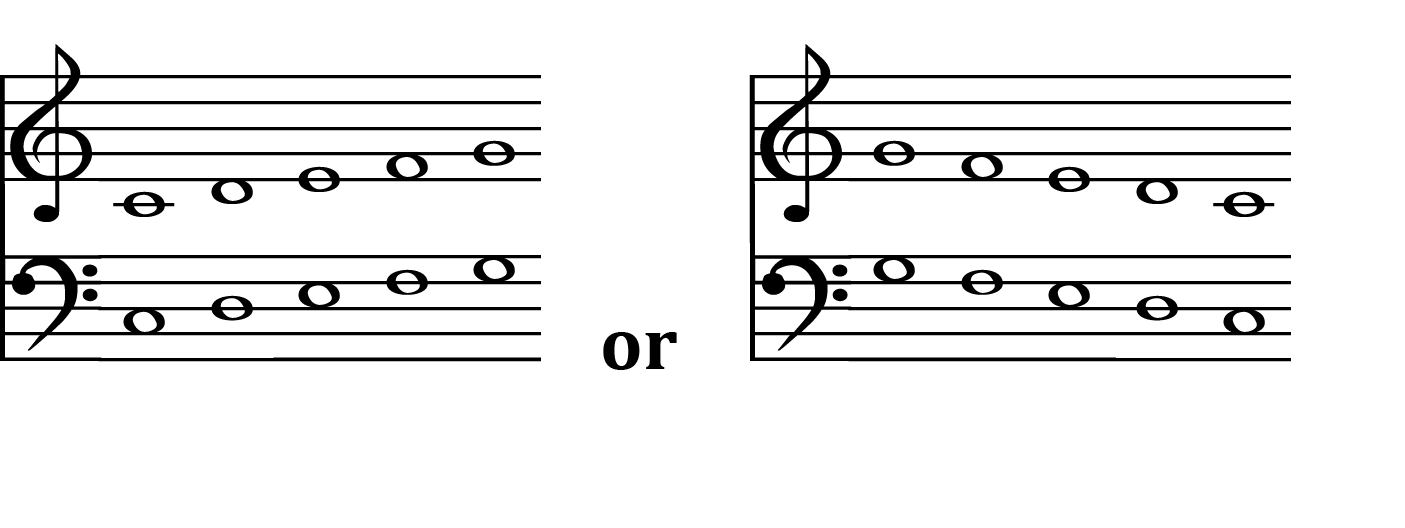
Italian musical term abbreviated to ‘pp’ that is placed under music to indicate the passage of music is to be played at the dynamic volume of ‘very soft’.

Italian musical term abbreviated to ‘ppp’ that is placed under music to indicate the passage of music is to be played at the dynamic volume of ‘very, very soft’.

Italian musical term abbreviated to ‘p’ that is placed under music to indicate the passage of music is to be played at the dynamic volume of ‘soft’.

A sounded note that is specific in frequency (measured using hertz).
Very fast. Italian name placed on top of music that describes the mood, feeling and general speed to use in playing a passage of music. Roughly from 168-200 bpm (beats per minute).
Q
A kind of note that tells player to hold a pitch for one beat. (in 4/4 or common time) It is made up of a colored in note head with a stem. Its value can change if the underlying beat (bottom number) in the time signature is something other than four which stands for quarter note.
A musical symbol that tells player to rest for one beat. (in 4/4 or common time)

R
Symbols that tell you to be silent for a specific duration. Whole Rest = 4 counts; Half Rest = 2 counts; Quarter Rest = 1 count; Eighth Rest = ½ count; Sixteenth Rest = ¼ count.
A pattern of sound using duration (holding) and accent of pitches.
Also written as rit. Gradually slow down. Usually at the end of a section or piece. This helps signal to the listener that the end is coming.
When placed next to a chord, it means to roll through the notes of the chord before holding instead of hitting all of the notes at the same time. Notes are usually rolled up through the chord. If they are meant to be rolled down, there will be an arrow at the bottom of the roll sign.
The Romantic period of music covers an approximate time-period from 1820-1920. The music from that period reflects styles and traditions that were popular across art and culture during that time. Particular traits that define music from the romantic period are: Tempo changes – playing in a rubato style which means speeding up and slowing down. These were more possible to coordinate between large groups of players due to addition of conductors, who could stand and guide the entire group. Much bigger contrast in dynamics. Very dramatic and emotional. Harmonies began to become more complex using more than simple triads and more dissonance.
Refers to a chord in its position straight from the scale (1, 3, 5 of scale).
Triad
7th Chord
A style of playing that stretches and pulls time rather than being strictly metrical. Very common in the Romantic Period.
A string of notes played quickly up or down. Often based on a scale.

S
A group of notes stepping up or down by a specific formula of intervals. Scales are the basic formula that music is built from, including chords, melodies and key signatures. See Major Scale and Minor Scale.
Playfully. Describes the mood or feeling a piece of music should be played with.
♯ This symbol is placed in front of a note to raise it by a half step. The line or space of the note goes in the center like a bullseye. When used as an accidental, it is good only for that specific pitch and lasts for the rest of the measure. When it is part of the key signature, it means to make every note of those letters sharp throughout the music (unless the key signature changes).
Notes move in the same direction but not necessarily by the same intervals.
Hold for one-fourth of a count. When using more than one in a row, they can be beamed together in groups. Imagine the flags being lifted up and stuck together — this makes it easier to see the number of notes in a grouping quickly.

Rest for one-fourth of a count.

Notes that skip up or down on the piano or staff. Skips on the staff go from line to line or space to space. Skips on the piano go every other key.
A curved line drawn over two or more notes. It shows that these notes are part of the same phrase and should be played “legato” (without lifting between notes). This is the same symbol used for a tie. You can tell the difference because a tie will be between two notes that are the same while a slur will be between 2 or more notes that are different.
Notes that sit on the space between two lines on the staff. The line touches either the top, bottom or both the top and bottom of the note. Seeing line notes, space notes and their specific location on the staff are important in being able to identify notes.

A dot placed over or under the notehead to show that the note should be played short and disconnected from the note after it.
A group of five lines and four spaces used for writing down music. Lines and spaces stand for specific pitches while the rhythm and time are notated across from left to right. Musical symbols are placed on the staff recording the main elements of a piece of music so that it may be recreated or performed by reading it.
Notes that stay on the same line or space of the staff and on the same key of the piano.
The part of the note that looks like the stem of a flower.
Notes move in the opposite direction of each other using the same intervals, either outwards or inwards.
The far right pedal on the piano. When pressed, it sustains (holds) the notes you’ve played. Normally, when keys are let up, felted pieces of wood inside the piano settle down on the strings to stop their ringing. The sustain pedal holds these dampers up, allowing the strings that are struck to continue ringing. It can be used to connect big jumps and chords or as an effect for certain types of music.
Markings that show where to use the sustain pedal. Bracket style: when the bracket begins, push the pedal down and hold it until you see a bump or the end of the line — the bump means change the pedal. When the line ends, let the pedal up. Ped/star style: when you see the Ped symbol push the pedal down; let it up at the ✱ symbol.


T
Italian musical term referring to how fast or slow a piece of music is played. Originally Italian names were used to give a description of speed and mood. With the invention of the metronome, tempo began to be measured using beats per minute (bpm). Both are still commonly used.
| BPM | Italian Term | Description |
|---|---|---|
| 20–40 | Grave | slow and solemn |
| 40–60 | Largo | slowly and broadly, dignified |
| 40–60 | Lento | slow |
| 60–66 | Larghetto | rather broadly |
| 66–76 | Adagio | slow and at ease, stately |
| 76–108 | Andante | walking pace |
| 108–120 | Moderato | at a moderate (medium) tempo |
| 120–139 | Allegro | quick and joyfully |
| 140 | Vivace | quick and lively |
| 168–200 | Presto | very fast |
Variations: -issimo = very | -etto = rather | -ino = slightly
How music works.
A curved line placed between two note heads of the same pitch. Shows that the note should only be played once but held for the combined value of both notes. These are used so that the eye can easily see each beat region of the measure making it easier and quicker to read accurately. Notes can not extend over the bar line and usually should not extend over the imaginary bar line. The same symbol is a slur if placed over two or more notes of different pitches.

Two numbers stacked on top of each other that are placed at the beginning of the music to tell how many beats per measure (top number) and what notes gets the beat (bottom number). Can also happen in the middle of the music if there is a time change. 4 = quarter note, 2 = half note, 8 = eighth note, 16 = sixteenth note

A sound or the character (desription) of a sound. It could be clear, sweet, etc. Can also refer to a specific sound on a keyboard. Some keyboards label the different sounds you can choose from ‘tones’.
Tranquil, calm. Describes the mood or feeling a piece of music should be played with.
Different kinds of clefs are used at the beginning of a staff to show the specific range of notes used in the musical notation. Treble means high so, Treble Clef indicates the higher range of notes from middle c on up. Is also called G Clef because it curls into the G line of the staff.
Symbol of 2 horizontal lines at an angle placed between two notes or two groups of it. Means to rock back and forth between the two quickly for the full value of both notes.

Symbol that looks like a zigzag. May see either the symbol or letters “tr ” over the note. The Embellishment begins on the scale note above the main note (unless modified by a sharp or flat) and returns to main. It is most often a four note grouping. If the trill symbol is extended, it means to continue the pattern to fill the amount of time it extends over.


A note value where three of a note fit where normally two would. Notes have a triplet bracket over them or just a 3. See Note Values.
Symbol that looks like a backwards “S” on its side. When placed over a note, it creates a four note embellishment that begins on the note above the main note in the scale (unless modified by a sharp or flat) and steps down twice before returning to main note. When it’s placed after the note, it begins with the main note then does the turn.


U
A zigzag symbol that is place over the note to indicate a specific embellishment of the note. To play an upper mordent, start with the main note , step up in scale (unless it’s modified with a sharp or flat), then step back to the main note. Also called an inverted mordent.
V
An instrument sound generated within a computer that runs inside a software program. It can be a sample (recording) of an instrument or synthesized (machine-created by mathematical algorithm). Often run as a subprogram inside music software such as a recording or publishing program. Its sound can be played (triggered) by a keyboard or other instrument connected to the computer by MIDI cable.
Lively and fast. Italian name placed on top of music that describes the mood, feeling and general speed to use in playing a passage of music. Roughly from 132-140
In music, this refers to loudness. Loudness in measure in decibels (db).
W
A kind of note that has notehead only. When it is used it indicates the pitch will be held for four counts. Its value can change if the underlying beat (bottom number) in the time signature is something other than four which stands for quarter note.
A musical symbol that tells player to rest (be silent) for four beats. (in 4/4 or common time) Looks like a hat in the position where it can hold something inside.
