Build your own practice: choose exactly what to drill, then play, or copy a homework link for a student.
📁
Basics
5 quizzes
Staff, symbols, lines & spaces, and the keys — no set note range.
📁
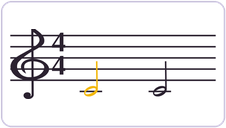
Rhythm & Beat
15 quizzes
Counting, note values, and rhythm.
📁
Middle C Position Ranges
5 ranges
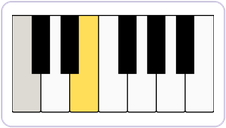
C · D · E
The three notes just above Middle C.
C · D · Enotes highlighted
C · B · A
The three notes just below Middle C.
C · B · Anotes highlighted
A – E
A five-finger span from A up to E (A3–E4).
A3 – E4notes highlighted
F & G
F and G in both hands — before the full Middle C Position range.
F & Gnotes highlighted
Middle C Position
Both thumbs share Middle C — F3 up to G4, including the notes between the hands.
F3 – G4notes highlighted
📁
C Position Ranges
5 ranges
Simple C & G7
C3, F3, G3 — the notes that build the simple C and G7 chord shapes.
C · F · G (bass)notes highlighted
CFG & CDE
The C·F·G chord notes, plus C·D·E in the treble.
C · F · G + C · D · Enotes highlighted
C Position
Both hands in C-chord position: C3–G3 and C4–G4 (no notes between the hands).
C Positionnotes highlighted
EFG
E3, F3, G3 in the bass.
E · F · G (bass)notes highlighted
EFG & CDE
E·F·G in the bass, plus C·D·E in the treble.
E · F · G + C · D · Enotes highlighted
📁
Bass Ranges
7 ranges
C3 – G3
C3, D3, E3, F3, G3 — a five-finger C position in the bass clef.
C · D · E · F · G (bass)notes highlighted
F3 – C4
F3, G3, A3, B3, C4 — reading up from F to middle C.
F · G · A · B · C (bass)notes highlighted
C3 – C4
A full octave in the bass clef — C3 up to middle C.
C · D · E · F · G · A · B · C (bass)notes highlighted
C2 – E2
Low bass, two ledger lines below.
C2 – E2notes highlighted
F2 – B2
The low bass notes just under the staff.
F2 – B2notes highlighted
C2 – B2
The low-C octave in the bass.
C2 – B2notes highlighted
C2 – C3
The octave from Low C up to C3.
C2 – C3notes highlighted
📁
C3 – C5 Ranges
2 ranges
A4 – C5
The step up from Middle C to C5.
A4 – C5notes highlighted
C3 – C5
Two octaves around Middle C, C3 up to C5.
C3 – C5notes highlighted
📁
C5 – C6 Ranges
3 ranges
D5 – G5
The four notes above the treble staff's C5.
D5 – G5notes highlighted
A5 – C6
Reaching up to High C above the staff.
A5 – C6notes highlighted
C5 – C6
The octave from C5 up to High C.
C5 – C6notes highlighted
📁
Full / Multi-Octave Ranges
5 ranges
Anchor C's
All five C's — Low, Medium-Low, Middle, Medium-High, High.
Anchor C'snotes highlighted
C2 – C4
Two octaves in the bass, Low C to Middle C.
C2 – C4notes highlighted
C4 – C6
Two octaves up top, Middle C to High C.
C4 – C6notes highlighted
A4 – C6
The upper reaches, A4 to High C.
A4 – C6notes highlighted
C2 – C6
The full four-octave span, Low C to High C.
C2 – C6notes highlighted
📁
Theory
1 topic
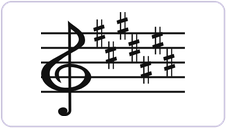
Key Signatures
Match each key signature to its major key — sharps and flats, one group at a time.
📁
Chords
2 topics
Triads
Name, build and play triads, spelled from each root scale — keys in circle-of-5ths order, qualities in the order we introduce them. Each set lets you choose how to practice: name it or build it, on the keys or the staff, or play it on a MIDI keyboard. Start with the Custom Chord Quiz Engine: pick exactly the keys, qualities and inversions, then play — or copy a homework link.
7th Chords
Major 7th, dominant 7th, minor 7th, half-diminished, diminished 7th, augmented 7th, minor-major 7th, and major & minor 6th — in root position and all three inversions, as left-hand shapes, or as two-hand voicings with the melody on top. Use Chords from a song to drill the exact chords of a jazz tune.
📁
Guitar
10 sets
Guitar Tools
Tune up before you play, and find (or build) any chord diagram to copy into a song sheet.
Open Strings
The six open strings, low to high: E A D G B E. Strum them without pressing a fret.
E · A · D · G · B · Eopen strings
1st String (E, F, G)
First position on the 1st string: E (open), F (1st fret), G (3rd fret).
E · F · G1st string
2nd String (B, C, D)
First position on the 2nd string: B (open), C (1st fret), D (3rd fret).
B · C · D2nd string
3rd String (G, A)
First position on the 3rd string: G (open), A (2nd fret).
G · A3rd string
4th String (D, E, F)
First position on the 4th string: D (open), E (2nd fret), F (3rd fret).
D · E · F4th string
5th String (A, B, C)
First position on the 5th string: A (open), B (2nd fret), C (3rd fret).
A · B · C5th string
6th String (E, F, G)
First position on the 6th string: E (open), F (1st fret), G (3rd fret).
E · F · G6th string
Strings 1–3
Review: every first-position note on the 1st, 2nd and 3rd strings.
Strings 1 – 3first position
Strings 4–6
Review: every first-position note on the 4th, 5th and 6th strings.
Strings 4 – 6first position
First Position (All Strings)
All 17 first-position notes, on every string.
All stringsfirst position
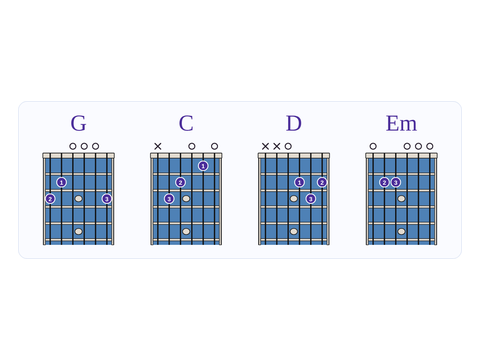
Guitar Chords
Build the chord on the diagram, name it, find its diagram, or play it on a real guitar. Start with the Custom Guitar Chord Quiz Engine to pick any chords, or type the chords of a song.
Chordsbuild · name · find · play
🚧
Coming Soon
3 topics
Voice Coming soon
Singing and pitch-matching quizzes are on the way. Check back soon!
Ear Training Coming soon
Hear it, then name it: notes, intervals and chords by ear. Quizzes are on the way. Check back soon!
Drums Coming soon
Reading drum notation and grooves. Quizzes are on the way. Check back soon!
 5 engines
 5 quizzes
 15 quizzes
 1 topic